
The Winnebago County Arrest Log
The source is the rolling Jail Media Blotter PDF. Around a weekend or holiday, the file can stretch across several days. One Monday run printed 6:00 a.m. as its close. Its window opened the prior Friday at 6:00 a.m. and ran through 6:00:01 a.m. that Monday. That June 8, 2026 example shows how the math works. The title still said "24 HOUR PERIOD: ALL BOOKINGS AND RELEASES." So the arrest log is a window reading, not the label's promise.
The county keeps one current endpoint. Older weekend PDFs sit behind no clear archive list. The entry's Date Of Arrest and the report's closing date are separate data points. The report mixes bookings with releases. A listed person may be out of jail.
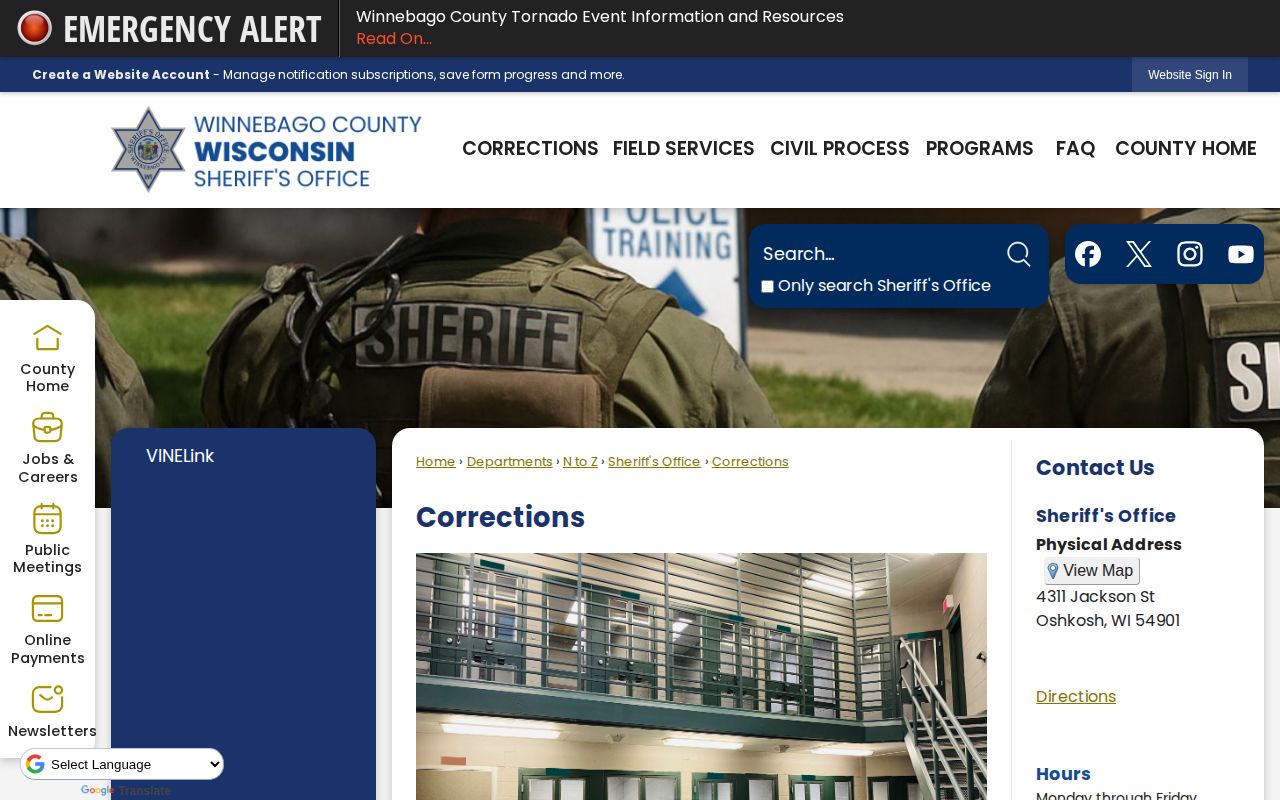
The Winnebago County Corrections page posts the rolling blotter.
How to Read the Winnebago Blotter
Start with the PDF header, not the file name. Read the printed run date, the start and end times, and the line about bookings and releases. Then treat each event row as one report entry. Agency codes like WISO, OSPD, NEPD, FCPD, MEPD, WCJ, and DOC identify the arresting agency printed by the jail. A code names the agency on the page. It does not prove that agency handled every event in that municipality.
- Save or open the current official PDF from the Corrections page.
- Write down the full “BLOTTER FOR” range and the run time.
- Search a name only after checking spelling, and do not merge similar names.
- Read the arrest date, agency, charge or hold type, and release fields as separate columns.
- Check the Current Inmate List for present custody and WCCA for later court events.
When a weekend catch-up rolls several days into one file, the arrest log is the right tool. Want the latest single-day picture instead? The 24 Hour Arrests page fits that question better. That split keeps a weekend report from being mistaken for an instant feed.
A blotter entry can be a release event. "Released To" is a printed destination when the county supplies one. "Reason For Release" gives a short cause. Neither field tells the story of a court case. A release can happen before a case ends, and a roster row can linger for an older matter.
What an Arrest-Log Entry Shows
The Media Blotter field line runs "Name | DOB | Charge(s) (Hold Type) | Type of Arrest | Reason For Release | Released To | Arresting Agency | Comp# | Date Of Arrest." The table is event-centered. It carries no full court docket. It prints no booking-photo column. Keep the word "charge" tied to the booking record, where it belongs.
| Entry field | Practical reading |
|---|---|
| Name and DOB | Identity fields printed by the county; do not rely on a name alone |
| Charge(s) (Hold Type) | Booking charge or hold, not a court result |
| Type of Arrest | County’s event classification |
| Reason For Release | Short release reason when the row records a release |
| Released To | Printed release destination, not a disposition |
| Arresting Agency | Agency code such as OSPD, NEPD, or FCPD |
| Comp# | Report or complaint identifier |
| Date Of Arrest | Arrest event date, distinct from the multi-day report range |
The Current Inmate List uses different fields. They include InmateID, Name, Sex, Jud. Status, and Initial Booking. So one document can hold a name the other lacks, without any contradiction. The list shows custody at its run time. The blotter is a dated event window. Keep both labels straight when comparing them.
Need a report, audio, video, or photograph missing from the PDF? The county's records process is the route, and the sheriff FAQ lists "Photos" as a category. The county posts no fixed booking-photo fee and no guaranteed online delivery. Limits can apply for juvenile status, protected people, safety, or an active investigation.
Weekend and Holiday Arrests
Weekend roll-ups define this county log. A Monday report can open with a Friday-to-Monday range. An event may look older simply because it first appeared after the gap. Publication timing shows when the county assembled the window, not when each arrest happened. Holidays produce the same effect. The PDF's own header controls what to call it.
Never stretch a multi-day report into a claim that nothing happened outside its window. A booking can arrive late or get corrected. It can sit under protection, or hide inside an agency code. Wondering whether someone is held right now? Open the Current Inmate List and check its run date. For status changes, Wisconsin VINE is a separate option.
The report is not a city-by-city census. Codes for Oshkosh, Neenah, Fox Crossing, Menasha, the sheriff, the jail, DOC, and others can share one file. A city police record may carry an earlier incident time. The county booking row then lands in the next roll-up. Treat the county log and a city news release as related records, not duplicates.
Local news adds a selective layer on top of the blotter. The Oshkosh Herald crime coverage page shows that angle.
Archives and Retention for Arrest Records
Winnebago County posts only its newest blotter file. Older PDFs have no documented public archive. Search engines sometimes surface a stale copy. Rogue roster mirrors do the same thing. Neither one matches the county's own file, so treat them as clues rather than records. If you need an older arrest range, save the exact PDF, note its printed run date, and ask the sheriff's records custodian for the booking record behind it.
Retention follows its own rules. Chapter 12 of the Winnebago County code sets eight years for Arrest Records and for Jail Division Daily Booking Records. That schedule does not promise the public URL stays live for eight years. It also skips any separate photo retention period. Ask the custodian whether a photograph sits inside the arrest series, the booking record, an incident file, or another digital attachment.
History runs on a different track. The Wisconsin Historical Society moves local records of permanent value through the State Archives process, though no Winnebago Sheriff booking-photo collection appears there. Archive searches help with old questions. They cannot tell you who is in custody now. Local papers work the same way. The Oshkosh Herald, Neenah News, Northwestern, Post-Crescent, FOX 11, WBAY, WTAQ, and WHBY pick which arrests to cover, often later than the county does.
Note: An old PDF or news story needs its printed or publication date beside it; a current custody claim should never rely on a historical copy.
From Blotter Entry to Court Result
A jail log captures one event: an intake or a release. Court records live elsewhere. Wisconsin Circuit Court Access shows public court events once a case is filed and available. The Clerk of Courts handles county-level guidance on court records. Timing matters here. A fresh booking may not have a searchable complaint yet. Someone in the Winnebago County jail could be serving a sentence, held on probation, or waiting on another jurisdiction.
Use the court's exact language. A first appearance is its own event. A bond decision sets a release condition. The disposition is the outcome recorded later. When WCCA lists dismissal, amendment, reduction, acquittal, plea, or sentence, copy that wording and the docket date. If nothing shows up, say the public search returned no disposition.
The county-wide Winnebago County recent-arrests page covers the records-request path, DOC and federal distinctions, and the difference between a current roster and an event blotter. The arrest log has a narrower job. Read the printed range. Learn the fields, and know when to ask for the underlying record.